Our Research
The UC Davis Department of Plant Sciences is a leader in researching, teaching, and delivering all aspects of plant science, from lab to field, forest to rangeland and beyond.
We are committed to our land-grant mission, established by the U.S. Congress in 1862, to provide quality higher education and address society's needs. We address our world’s agricultural, ecological and environmental needs through cutting-edge science, dynamic undergraduate and graduate education and exemplary outreach.
With numerous research projects across the department, it is challenging to summarize our work on one page. If you are looking for something in particular, we suggest searching the site or looking up a faculty profile. The profiles link to laboratory websites and provide more detailed information.
Agricultural Experiment Station
Most Plant Sciences faculty also hold appointments in the Agricultural Experiment Station (AES). The AES is not a place as much as a mission. Faculty members with AES appointments are responsible for meeting their departments' research and teaching needs and conducting mission-oriented research. This entails the expectation of distributing research findings to the relevant audiences.
Cooperative Extension
Nearly a third of the Department of Plant Sciences faculty hold full or partial appointments as Specialists in Cooperative Extension. These CE specialists conduct applied research and participate in statewide outreach programs, contributing to the University of California's research, education, and outreach mission. Learn more about UC ANR.
Smart Farm Big Idea
The Smart Farm Big Idea seeks to develop innovative farming and food system solutions to meet the pressing challenges facing agriculture and ensure that people in California and the world have access to safe, healthy and nutritious food. In collaboration with industry, community, and philanthropic partners, Smart Farm seeks to capitalize on UC Davis's strengths, from soil health and seeds through plant and animal sciences to food processing and human health.
Our Facilities
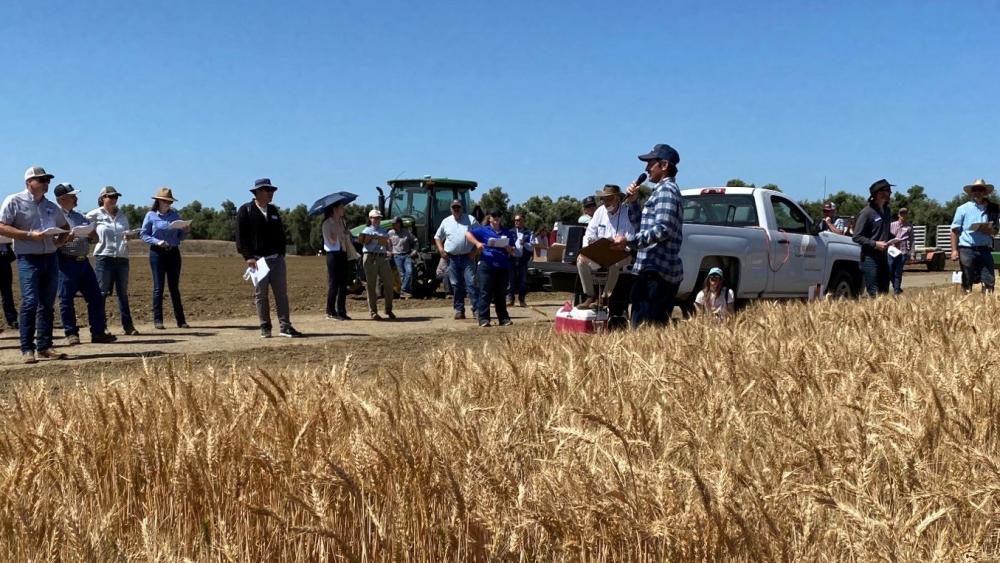
The department has field research facilities near the Davis campus that support our research, teaching and outreach missions.
- The Plant Sciences Field Station includes nearly 1,000 acres of cropland and over 90,000 square feet of laboratory, workspace, storage, and other building space.
- The 600-acre “vegetable crops” site west of the Davis campus primarily focuses on small grain, row crops, forages, seed crops, and annual fruit and vegetable crop systems.
- The nearly 200-acre “pomology” field site, also west of the campus, focuses on breeding, physiology, and fruit and nut tree crop production practices.
- The 175-acre Wolfskill Experimental Orchard is located south of Winters, California, about 15 miles west of Davis. This location is focused on fruit and nut tree crops, strawberry breeding and 75 acres devoted to a USDA-ARS plant germplasm repository.
In addition to the department-managed field research facilities, research is conducted at UC Research and Extension Centers (RECs) in other California regions. These facilities represent important regions and environments where agricultural and natural resource research occurs. Many of our faculty and students collaborate and conduct field research at other research facilities, including those of the University of California and California State University, or on-site in real-world agricultural or environmental settings.
On campus, departmental researchers utilize numerous resources and core facilities provided by UC Davis and the College of Agricultural and Environmental Sciences.
Wolfskill Experimental Orchards
The land comprising the Wolfskill Experimental Orchards was deeded to the University of California in three separate parcels. Frances Wolfskill Wilson donated the original 108 acres in 1934. Frances Wolfskill Wilson donated the Wilson tract, which was 28 acres, in 1953. The Masson tract of 20 acres was donated by Masson Land Enterprises in 1985.
In 1980, the Department of Pomology and the University of California, Davis, signed a long-term lease agreement with USDA ARS to establish the orchards of the National Clonal Germplasm Repository at Wolfskill. This repository includes stone fruit (peach, plum, nectarine, apricot, almond, prune), grape, walnut, pistachio, persimmon, olive, pomegranate, fig and kiwifruit germplasm.