



Pearce Wins Brandon Fellowship for Rice Research
Trials Aim to Give Farmers Better Tools for Nitrogen Management
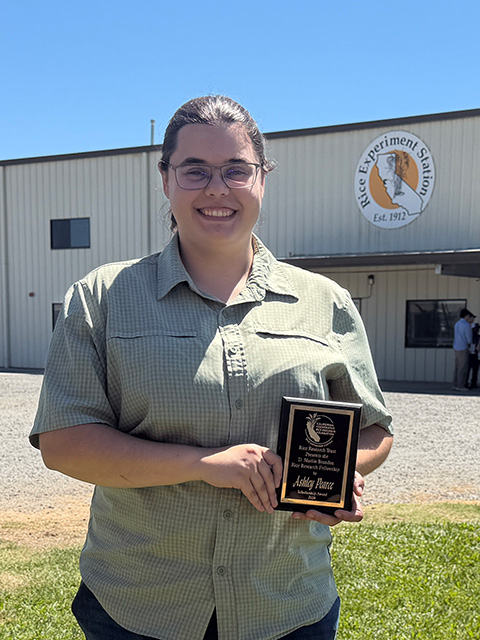
Pearce is a Ph,D. student with the horticulture and agronomy graduate group and studying with Bruce Linquist, a professor of Cooperative Extension based in the UC Davis Department of Plant Sciences. The focus of her research is nitrogen, an essential nutrient for plant growth.
Her aim “is to allow California rice farmers to make more informed decisions about the rate of nitrogen they apply to the specific variety they grow, rather than relying on a generalized application rate,” Pearce said. “This research is important because it may help California rice farmers decrease nitrogen inputs or increase yield outputs."
Pearce explained more about her research:
“I’m looking at the impact of varying levels of nitrogen on several of California’s commercially available rice varieties in a nitrogen variety trial.
“We collect information on canopy reflectance, phenology, lodging, grain quality and yield for all varieties and nitrogen conditions in our study. Data collection is conducted through several methods including drones, proximal sensors and manual measurements.”
Nitrogen application gets complicated, Pearce added.

“Increasing nitrogen in rice increases yield, but it also decreases the quality. Depending on their goals, some farmers may be interested in increasing their yields or increasing their quality. Since different rice varieties have different responses to nitrogen due to their underlying genetic differences, their nitrogen needs may be different, and the quality response may also be different.
“So, purely by yield metrics, it may look like farmers need to apply more nitrogen. But, if we pair this information with the quality responses, does this quality result make this increase worth it? Also, is the increase in yield worth the increase in fertilizer? That is for the farmers to decide based on their individual goals and their fertilizer economics.”
The use of nitrogen fertilizer in agriculture also has environmental impacts as excess nitrogen flows into local waterways and habitats.
About the D. Marlin Brandon Rice Research Fellowship
The Brandon memorial fellowship was created in 2000 to support students pursuing careers in rice production science and technology. It’s a tribute to D. Marlin Brandon, who was director and agronomist at the Rice Experiment Station in Biggs from 1985 to around 2000. Funding for the award has come in part from the California Rice Research Board and the Rice Research Trust.
Media Resources
Trina Kleist is a communications specialist with the UC Davis Department of Plant Sciences. [email protected] or (530) 601-6846.