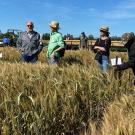
Erin McGuire, recently appointed executive director of the graduate program in international agricultural development, is expanding the program to embrace the larger system in which food is developed, grown and consumed.
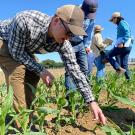
Ashley Pearce is trying to help rice farmers decrease fertilizer or increase yield by testing different levels of nitrogen on different varieties in different conditions.
Grad student Ana Zepeda offers tips for disaster planners, culled from interviewing women who lead community gardens in San Juan, Puerto Rico, after Hurricane Maria.
Ph.D. student Anca Barcu has been recognized for leadership in promoting health and well-being among students, including awareness of resources and accessibility in her teaching.
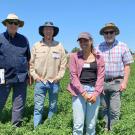
Steve Fennimore and Kassim Al-Khatib received top honors at a recent meeting of the California Weed Science Society. Plus, three students, also from the UC Davis Department of Plant Sciences, won awards.
Scientists Pershang Hosseini and Matt Fatino discuss their research for controlling the parasitic plant Orobanche, commonly called broomrape. Strategies include drawing down the bank of seeds in the soil, adding herbicide to irrigation water and timing transplants going into infested fields.
Kelly Paglia, advisor for the horticulture and agronomy graduate group, received an Award for Excellence in Service to Graduate Students from the UC Davis Graduate Student Association. Students call her "a gem," and Paglia says "we'll get to the end together."
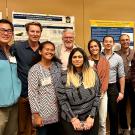
Alfalfa expert Charlie Brummer says it's time to "think about redesigning the alfalfa plant from first principles," after 40 years of frustrated efforts to increase yield. He made the remarks at a recent meeting of the North American Alfalfa Improvement Conference. Students also presented their research, including trials to grow the crop with less water.
Alfalfa offers a drought-resilient, high-protein crop for both livestock and human use. UC Davis researchers are exploring ways to improve yield, protein extraction, and resilience while testing almond shells as a soil amendment to enhance water infiltration.
UC Davis researchers are exploring how byproducts from anaerobic digesters, rich in nitrogen, can serve as fertilizers for wheat and triticale. Early results show promise for forage crops, potentially reducing chemical fertilizer use and costs.