



California Wolves Feed Heavily on Cattle, Study Finds
New Research Shows What Wolves Are Eating and How Livestock Respond to Their Presence
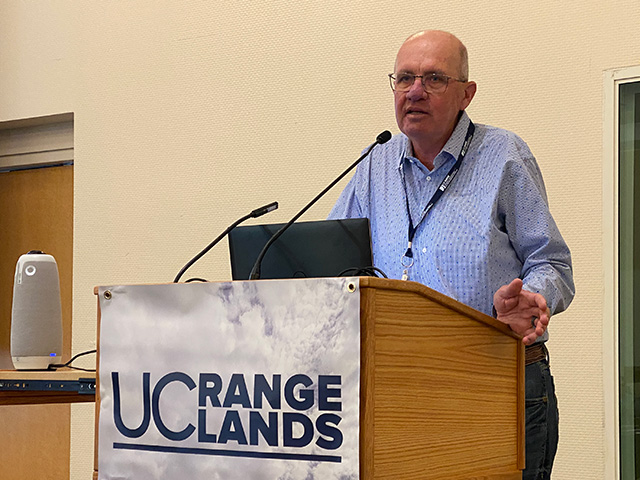
Two new studies looking at gray wolves in California paint a complex picture of life on the state’s ranching landscapes: Wolves eat cattle more than anything else, and the presence of the predators causes significant stress among livestock.
In the first study, University of California, Davis, researchers found wolves from the Lassen and Harvey packs in northeastern California were primarily eating cattle. They collected scat samples during the summer months of 2022 and 2023 and found 72% of wolf scat contained cattle DNA. The research was published in PLOS One.
“Whether it's through scavenging or whether it's through depredation, it’s a huge component of the wolves’ diet,” said lead author Tina Saitone, a professor of Cooperative Extension in the UC Davis Agricultural and Resource Economics Department. “Their conservation success is because of livestock producers in the state.”
The late Kenneth W. Tate, a professor of Cooperative Extension in the Department of Plant Sciences and an expert in rangeland and watershed management, co-led the development of the original research framework. It was his last big project in collaboration with Saitone, his wife, before dying suddenly in 2025. Tate is a co-author on both studies.
In the first study, scientists found cattle DNA in 86% of the scat samples collected in 2022 and 55% of samples collected in 2023. While all 2022 samples were from the Lassen pack, the 2023 samples included eight collected from the newly established Harvey pack.

Wolves are a state and federally recognized endangered species. The first confirmed wolf entered California from Oregon in 2011, following an absence of nearly 100 years. The California Department of Fish and Wildlife estimates the state is now home to nine wolf packs.
Few natural prey
Wolves in California now live in landscapes shaped by people, with fewer wild prey options than wolves in some other part of North America. Mule deer are their only significant wild food source, but populations here have dropped sharply since the 1970s. (In other areas, wolves typically feed on hoofed animals such as elk, moose, white-tailed deer and bison.)
The scarcity of wild prey in California may be one reason wolves are eating cattle instead, Saitone said. Researchers found mule deer in just 45% of the scat samples.
Keeping wolves away from cattle is difficult on many working landscapes.
“Conservatively, we’re talking about a million acres in our study area and 10,000 cow-calf pairs,” Saitone said. “It’s not as simple as putting up an electric fence on a two-acre pasture or putting cattle in the barn at night.”

Cattle are stressed
Researchers also examined how living among wolves affects cattle. Their findings suggest the costs of wolf reintroduction extend well beyond animals lost to predation.
A second study, published in Ecology and Evolution, measured cortisol levels in tail hair samples collected from beef cattle grazing on rangelands in northeastern California — some herds sharing territory with wolf packs, others in areas without wolves. Cortisol, often called the stress hormone, accumulates in hair over time, making it a reliable indicator of chronic stress rather than a momentary response to fright.
Cattle herds living among wolves had cortisol levels 58% higher than those in control herds — a significant physiological difference. This marks one of the first times hair cortisol analysis has been used to study how the reintroduction of predators reshapes livestock physiology in the field.
"What this really confirms is that death or depredation is not the only impact here," Saitone said. "Living among wolves, for cattle, is a chronically stressful experience, and that could ultimately have production-related impacts in both the short and the long term."
Could it affect reproduction?
The findings are just a starting point, Saitone added. Next, researchers want to understand whether elevated stress levels translate into lower conception rates. It’s a concern long raised by ranchers that has not yet been established through direct biological evidence. When breeding cows fail to conceive, it can directly affect a rancher’s bottom line.
"That's their whole purpose,” Saitone explained. “These are mother cows that are supposed to be generating calves as a marketable product.”
Other authors of the PLOS One study include Benjamin J. Sacks of UC Davis. Funding came from the Russell L. Rustici Rangeland and Cattle Research Endowment and California Cattle Council.
Christina Nord was corresponding author of the Ecology and Evolution study. Other authors include Alexander Pritchard, Rosemary A. Blersch, Brenda McCowan and Jessica J. Vandeleest. Funding came from Western Sustainable Agriculture Research and Education and the Russell L. Rustici Rangeland and Cattle Research Endowment.
Media Resources
- Tina Saitone, Department of Agricultural and Resource Economics, [email protected]
- Amy Quinton, News and Media Relations, [email protected] 530-601-8077
- Trina Kleist, Department of Plant Sciences. [email protected] or (530) 601-6846.