



Fennimore, Al-Khatib Honored for Careers in Weed Science
Students take top awards at annual CWSS conference

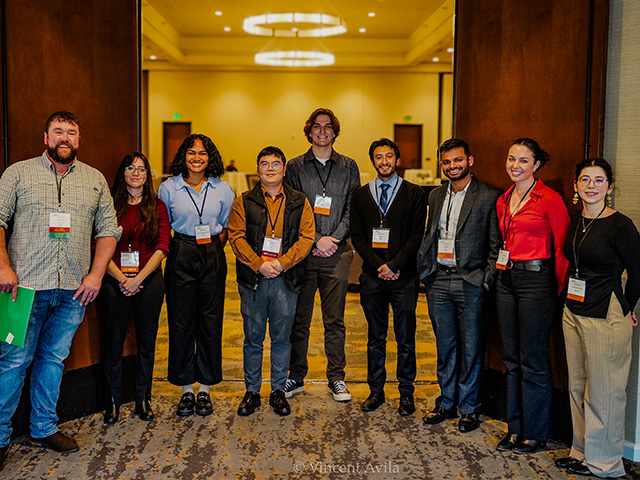
Steve Fennimore and Kassim Al-Khatib were among the weed scientists from the UC Davis Department of Plant Sciences who earned top honors at a recent meeting of the California Weed Science Society.
Fennimore, a professor of Cooperative Extension, received a Lifetime Achievement Award for his impactful career in weed science. He is widely known for advancing mechanization to manage weeds among specialty crops, and for pioneering an herbicide program that works for pesticides as a popular soil fumigant was phased out. Richard Smith, now retired from University of California Cooperative Extension, nominated Fennimore and presented the award.
Al-Khatib, a professor, was named an honorary member for making significant contributions to weed science and agriculture in the state. Whitney B Brim-Deforest, of UC Agriculture and Natural Resources and a former student, nominated Al-Khatib and presented his award. Al-Khatib is the Melvin D. Androus Endowed Professor for Weed Science and co-director of UC’s Western Integrated Pest Management Center.
The CWSS annual conference was held Jan. 28-30 in Santa Barbara with the theme, “Back to Basics.”
A CWSS board member called Fennimore “truly a gift to the weed science community.” “His innovative work in steam technology and robotics places him at the forefront of modern weed management,” added Tom Getts, and weed advisor for University of California Cooperative Extension. He praised Fennimore’s “impactful research, mentorship and service.”
Students in the department’s weed science program also received awards in student contests.

Tong Zhen: 1st place for oral presentation
Tong Zhen, a doctoral candidate in the lab of Brad Hanson, took first place for an oral presentation of his research. His topic was, “Evaluation of Branched Broomrape (Phelipanche ramosa) Seed Responses to Nitrogen Fertilizers and Flooding.”
“I conducted this research to test the potential for two cultural controls on branched broomrape, using fertilizer management and flooding. We did two lab experiments: One treated branched broomrape seeds with nitrogen fertilizer at different germination stages, and the other simulated a flooding environment in the lab to test the response of the seed.”
Zhen also took second place in the graduate student poster contest. His topic was, “Evaluation of Electrical Weed Control in California Organic Blueberries.”
“This is a summary of three years of research to test the crop safety, soil health and weed control efficacy of the new technology,” Zhen said.
Kekoa Nelson: 1st place in poster contest

Kekoa Nelson is a doctoral student in the lab of Justin Valliere, an assistant professor of Cooperative Extension in the department. Nelson took first place in the graduate student poster contest for her work, “Prescribed fire in serpentine meadows of varying restoration management histories.”
In the poster, Nelson presented the preliminary results of vegetation surveys she conducted in spring 2025.
“Using the serpentine meadows at McLaughlin Natural Reserve, I am conducting a multi-year, prescribed-fire monitoring project focused on native plant restoration in areas that have different histories of invasive plant management,” Nelson wrote.
Nelson compared areas that had been actively managed for invasive plants using prescribed burns, hand pulling and chemical treatment to remove invasive species, with areas of low management consisting of spot treatment, grazing or no active restoration.
“This division in management has left the landscape bisected, composed of sections high in native flora and other sections dominated by invasive and non-native flora,” Nelson noted. She used those differences to see how the different areas would be impacted by prescribed fire and how species would flower come spring.
“More-managed sites had higher native richness and cover, and lower nonnative cover and biomass, compared to less-managed sites,” Nelson found.
“We’re incredibly proud of Kekoa for highlighting research that will directly inform the use of prescribed fire in California’s unique serpentine grasslands,” Valliere said.
Robinson Johnson: 1st place in poster contest
Robinson Johnson took first place in the undergraduate poster contest with his research, “Biology and Control of White Fire Weed.” He studies with Al-Khatib.
“My project was on a species of broadleaf weed newly introduced to California. It’s known as white water fire (Bergia Capensis L.),” Johnson wrote. Native to Africa and Asia, it was first detected in Butte County rice fields in 2023. The low-spreading plant “is already a major weed competitor elsewhere…
“I aimed to identify differences between white water fire and redstem (Ammania L.), which is already present, for easier field identification,” Johnson wrote. He is “also researching management techniques to prevent it from becoming a major competitor.”
“The success of my students in their careers and lives is something I am proud,” Al-Khatib added.
Related links
Learn more about weed science research at UC Davis and get helpful information here.
Learn more about the California Weed Science Society here.
Read more about Steve Fennimore and his reflections on his career here.
Media Resources
- Trina Kleist, UC Davis Department of Plant Sciences, [email protected] or (530) 601-6846 or (530) 754-6148.