



(Mickie Tang/UC Davis)
A Call to Action: Wong Proposes Standards for Researching Microplastic Effects on Food Crops
Ideas from Taylor Lab: Develop Realistic “Recipes,” Study Entire Plant Growth Cycle
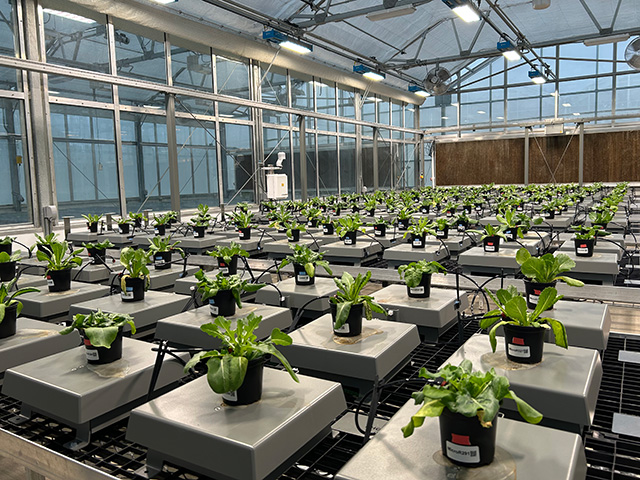
Tiny bits of plastic are everywhere, including in the plants we eat and the soil they grow in. Scientists have measured the plastic bits, called microplastics, in tomatoes, lettuce, carrots, wheat, rice and apples, among other crops. They’ve also measured how these microplastics interact with living things in the soil and with plants themselves to change how plants take up water, grow and make seeds, among other basic functions.
Although the number of studies is growing, there aren’t any standards for scientific experimentation that would make it easy – and relevant – to compare the results of one study with those of another, or to clearly understand how they relate to real-world agriculture.
To solve that problem and make future research more useful, scientists in the UC Davis Department of Plant Sciences are proposing that researchers get together to set standards for their microplastic experiments. The idea is akin to what scientists did decades ago to standardize research to understand the effects of air pollution. They also are suggesting four founding principles to guide those standards.
Amanda Wong, a Ph.D. candidate in the department, reviewed more than 50 studies published over the last five years on microplastics in soil and their impact on plants. Most showed microplastics cause problems in the early stages of plant development that go on to impact growth and yield. They also revealed different effects – including some that are positive – depending on the type and size of the plastics, the plants being studied, the material the plants were grown in and other factors.

One of the biggest issues in the studies was the concentration of plastic particles scientists had used for the work. “Many of these studies used a high dose of microplastics in their experiments,” Wong said. “But those doses don't reflect microplastic concentrations we currently see in agricultural soil.”
Wong assembled her literature review while working with Gail Taylor, a distinguished professor emerita in the department and now dean of Life Sciences, University College London. Wong’s review was published within an emerging research topic collection in the journal Frontiers in Plant Science.
“This work is a call to action for future research,” Wong added. “We need to know where plastic pollution is found in soils and how much is there, and we need to conduct our experiments using realistic plastics under real-world conditions.”
Four principles to guide future research
Among the patterns Wong found is that plants can absorb plastics that are 1 micron and smaller in size. A micron is one thousand times smaller than a millimeter, or 70 times smaller than the diameter of an average human hair.
Additionally, some broad categories of plants may be less sensitive to microplastics than others. The categories depend on how many leaves first pop out of the ground, one leaf (less sensitive) or two (more sensitive). Wong called this “a working hypothesis” that could be useful but needs more study.

The four principles Wong suggests as a result of her review are:
- Develop standardized mixtures – she called them “recipes” – of plastics for experimentation. In addition to microplastics, include in those recipes even tinier particles called nanoplastics to represent the range of bits actually found in agricultural soil. Nanoplastics are measured in nanometers; one nanometer is one million times smaller than a millimeter.
- Use realistic concentrations of microplastics and nanoplastics to represent what is currently found in both rural and urban environments. (Urban concentrations are usually higher, according to the research Wong reviewed.)
- Prioritize experiments that define the inflection points where these pollutants begin to cause problems in the plants.
- Plan experiments to cover the whole growth cycle of plants, rather than the usual practice of short-term trials. This would give researchers a complete picture of impacts on plant biomass and yield, root and shoot growth and key plant processes such as photosynthesis. Some studies show microplastics can reduce all these.

Meanwhile, Wong has moved forward to explore microplastics in California agriculture broadly. That includes fields close to home, with a project to measure pollution in the soil of farms here in Yolo County and across the Central Valley. (Read more about that research here.)
Building on that, Wong added, “I just completed a greenhouse experiment with lettuce grown in soil with realistic microplastics made from plastic mulch at a concentration relevant to what I found in California agricultural soil.”
Federal and local funding support
Wong’s research has been funded, in part, by a Graduate Student Research Award made possible by sources including the James Monroe McDonald Endowment, administered by University of California Agriculture and Natural Resources.
For this work, Wong received a Graduate Research Fellowship from the National Science Foundation.
Media Resources
- Wong’s paper is, “Plants and microplastics: Growing impacts in the terrestrial environment,” with Gail Taylor the principal investigator. It’s published within the special research topic, “Evaluating Plastic Residues’ Impact on Plant Health and Soil Ecosystems.” Read the paper here.
- Trina Kleist is a communications specialist with the UC Davis Department of Plant Sciences. [email protected] or (530) 601-6846 or (530) 754-6148.