



Coast Redwoods Slow Their ‘Breathing’ and ‘Eating’ When Temperatures Spike
Study Links Heat Waves to Worrisome Changes in the World’s Tallest Trees
California’s iconic coast redwoods are used to growing in cool, coastal areas where the average temperature is around 59 degrees F. But as average yearly temperatures rise and recent heatwaves spike to 100-degrees-plus, the trees are responding by slowing down the very operation that nourishes them, according to a study from the University of California, Davis.
When under heat stress, the world’s tallest trees slow photosynthesis, the chemical reaction that turns sunlight, water and carbon dioxide from the air into carbon the trees use to grow and perform other essential processes. It’s as if the trees slow their “breathing” and, as a result, their ability to “eat.” The findings raise alarm about the fate of one of California's two state trees, especially in their already vulnerable central, southern and eastern areas.
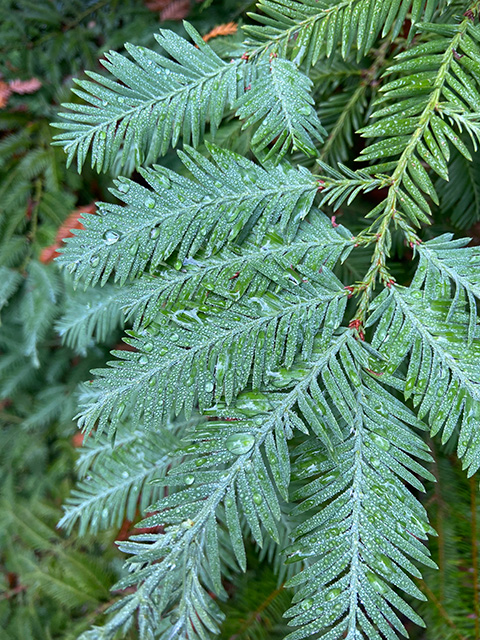
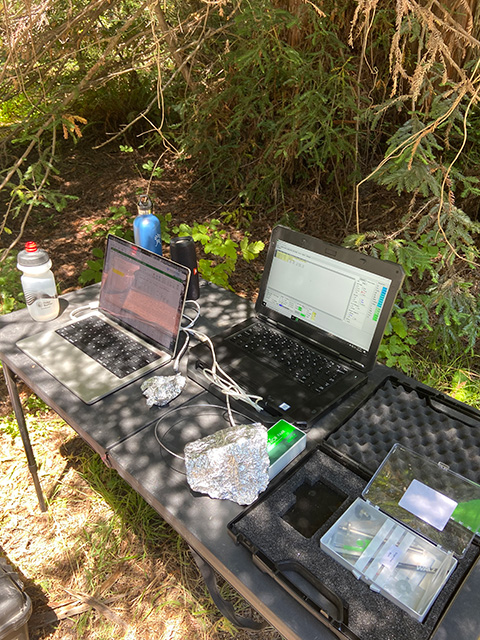
The study, published in JGR Biogeosciences, marks the first time anyone has looked at the effects of heat on coast redwood photosynthesis, said lead author Lily Klinek, a Ph.D. candidate with the Plant Optics Lab in the UC Davis Department of Plant Sciences. The team used an array of measurements taken over three summers in a redwood forest in Mendocino County.
When the mercury topped 86 degrees, as it did during the summers of 2022 and 2024, the temperatures of some leaves were nearly 20 degrees F higher than the temperature of the air. It’s a sign of stress.
“The leaves aren’t able to cool down,” Klinek said. It means they probably closed their stomata – the tiny, mouth-like pores that “breathe” in the air’s carbon dioxide. In the lab, further tests at temperatures ranging up to 110 degrees F confirmed photosynthesis was reduced, even when their “mouths” were open and were able to take in plenty of carbon dioxide.
“We don’t know what the upper temperature thresholds are for redwood photosynthesis and mortality,” Klinek said.
“With this work, we see there’s a significant impact of heat on photosynthesis and physiology. That’s an important start for figuring out what parts of the redwood range are at risk, knowing what to expect and trying to intervene for the health of redwood ecosystems.”
The study was funded by the National Science Foundation and California Forestry and Fire Protection, and it was conducted in cooperation with The Conservation Fund.
Redwoods 'sweat,' too – unless they’re thirsty
Under the right circumstances, trees can regulate their temperature through a process called evapotranspiration, which is closely linked to photosynthesis. They use those tiny mouths, or stomata, to “sweat” out some of the moisture they hold inside to cool off.
“It’s similar to the way we sweat to stay cool,” Klinek said.
The same heat spikes raising air temperatures also burn off the coastal fog that redwoods depend on for much of their water. The huge gap found between air and leaf temperatures indicated that the leaves likely closed their stomata to avoid losing precious water and overheated as a result, Klinek explained.
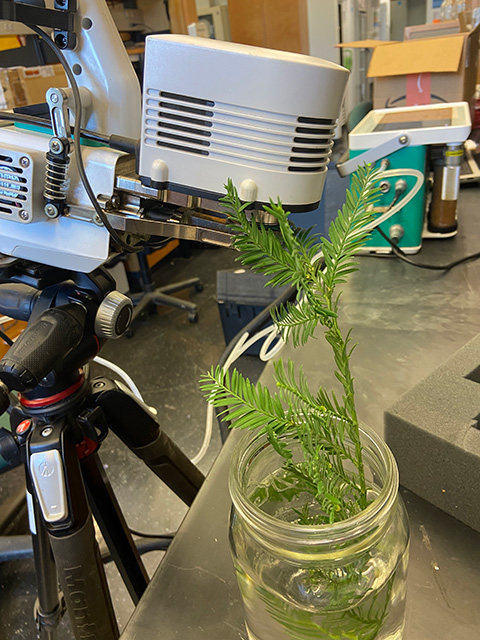
In the lab, the researchers put their leaf samples in jars of water, so they could sweat all they pleased. Still, photosynthesis was reduced, even as the leaves kept their stomata open.
“This means that, even if the redwood trees have more water to sweat with, the heat might still impair their breathing and functioning,” Klinek said.
Additional authors include Troy Magney, Jessie Au and Milagros Rodriguez-Caton of UC Davis; Mukund Palat Rao of Columbia University; Lauren Fety of The Conservation Fund; and George Koch of Northern Arizona University.

Media Resources
- Lily Klinek, UC Davis Plant Sciences, [email protected]
- Troy Magney, UC Davis Plant Sciences/University of Montana, [email protected]
- Kat Kerlin, UC Davis News and Media Relations, 530-750-9195, [email protected]
- Trina Kleist is a communications specialist with the UC Davis Department of Plant Sciences. [email protected] or (530) 601-6846.