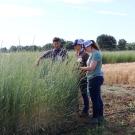
Central Valley farmers could keep their land in production by planting winter-time grains, even as California regulations reduce their allotments of groundwater for irrigation.
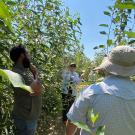
Cover crops provide a variety of benefits. Keeping living plants in the soil year-round improves soil structure and nutrients, stimulates soil organisms and provides homes and food for pollinators and helpful insects such as ladybugs.
A summer abroad program gives students a global perspective on how food systems, agricultural sustainability and communities are connected. Organized by Xiaofei Zhang, UC Davis Department of Plant Sciences.
A team of scientists, including Gail Taylor of the UC Davis Department of Plant Sciences, has identified a gene in poplar trees that enhances photosynthesis and can boost tree height by as much as 200 percent. Discovery of the “Booster” gene has enormous potential for both the nation’s efforts to create plant-based jet fuel and to boost the yield of key food crops.
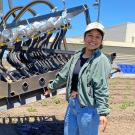
Steam treatment offers growers a chemical-free way to control weeds and soil-borne diseases, benefiting both crops and farmworkers. UC Davis research in Salinas shows it boosts yields while preserving soil health, making it a promising tool for organic farming.
A UC Davis study found most California farmers acknowledge climate change and seek adaptation strategies. Key concerns include water shortages, extreme heat, and wildfires. Farmers need financial aid, research, and policy support to boost resilience.
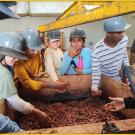
UC Davis and Universidad de La Salle students collaborated on a cacao project, fostering agricultural innovation and cultural exchange. A second project will focus on climate-smart cacao production and agroecology to strengthen Colombia’s food systems.
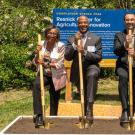
Construction officially began on the Lynda and Stewart Resnick Center for Agricultural Innovation with a groundbreaking event on May 29, celebrating the future $64.4 million facility at the University of California, Davis.
No-till annual wheat can boost soil carbon and maintain yields better than tilled wheat or perennial Kernza in California’s climate, according to new UC Davis research led by Mark Lundy. Study highlights benefits of conservation tillage.