



Oak Seedlings, Wheat, Bread and Water
Mitchell, Shydlowski and Wlaschin: Students Win Big at Ag Conference

Graduate and undergraduate students in the UC Davis Department of Plant Sciences made winning presentations at a recent agricultural conference, landing first place in their divisions for oral presentations and posters.
David Mitchell won for his talk about using soil organisms to restore native trees and bushes along streambanks. He is a member of the ecology graduate group and a Ph.D. student in the lab of Valerie Eviner, a professor and ecologist in the department and the University of California Agricultural Experiment Station.
Maya Shydlowski won for her presentation about getting the most out of winter wheat for the least amount of water. This research was done in the Grain Cropping Systems Lab led by Mark Lundy, an associate professor of Cooperative Extension based in the department. She is now a Ph.D. student in the horticulture and agronomy graduate group.
Morgan Wlaschin won for her poster showing how spring wheat, given moderate irrigation, still makes great bread – possibly even competing with wheat grown with full irrigation. She’s an undergraduate working with both Lundy and Shydlowski.
"Even on the margins, we can keep ag going in the Central Valley." -- Maya Shydlowski
The three presented at the CANVAS Annual Meeting on Nov. 11 in Salt Lake City. CANVAS is the new name for the annual meeting hosted jointly by the Soil Science Society of America, the American Society of Agronomy and the Crop Science Society of America.
Both Eviner and Lundy praised the students’ outstanding performances.
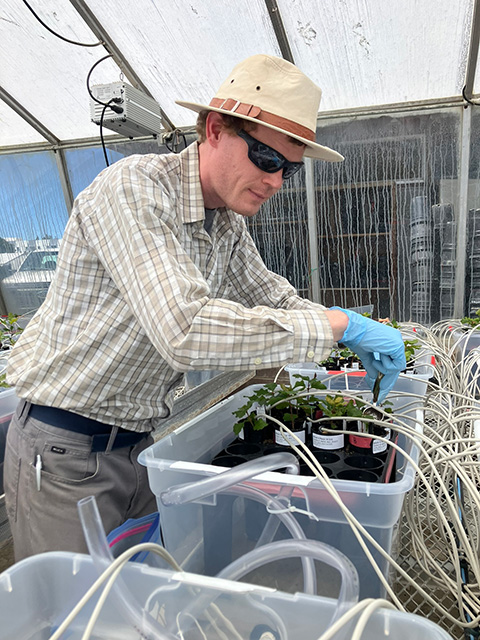
Mitchell: Underground connections help oak seedlings survive
Mitchell took first place in the Forest, Range and Wildland Soils Division with his talk, “Effects of soil amendments and inoculum on soil properties, tree and shrub growth and mycorrhizal colonization in a rangeland riparian site."
His research interest is the mycorrhizae -- the world of plant roots and fungi and how they interact and benefit each other. Fungi grow on and into roots, extending the plant's reach for water and nutrients. Plants give their fungi friends carbohydrates, which the fungi use to fuel their growth. They even communicate with each other, using chemical signals.
Mitchell wants to harness those underground connections to improve the survival of native oak seedlings. With that, Mitchell can boost efforts to restore oak forests along California's low-elevation rivers, where land previously had been converted to agricultural uses. People have removed trees, changed how water flows and spread harmful plants and pests.
“That’s where much native forest has been lost,” Mitchell explained. “My research tests whether soil management practices can boost beneficial mycorrhizae and suppress microbial pathogens in the soil.
“If we’re successful, we could increase survival and growth of riparian woody seedlings,” Mitchell added. His work so far has focused on Marin County, but he hopes to look further afield. Benefits down the line include improving regional water quality and wildlife habitat.
Read more about the work of the Eviner lab here.

Shydlowski: Options for growing wheat with little water
Maya Shydlowski landed in first place for her oral presentation, “How do planting date, water availability and genotype affect the water productivity of winter cereal crops in a semi-arid climate?” She won the Crop Irrigation Strategies and Management Community Student Competition.
Shydlowski has been testing winter wheat growing in different conditions: She’s measuring yield per unit of water used in California’s San Joaquin Valley, a region hard-hit by water shortages. She’s also looking at different planting dates, ranging from mid-fall to early winter. On top of that, she’s comparing growing the cereal for forage and for grain, which implies different harvest dates plus different levels of water use. To add to the project, the team also planted several varieties of barley and triticale and tested them in the same conditions.
“We showed that, with just a few inches of irrigation, a grower can likely get a decent crop,” Shydlowski said. “Now, the extent to which that is true depends on crop choice, variety choice, planting date, and whether you harvest for forage or for grain.”
Even more promising: “We found that as little as 4 inches of irrigation when the wheat is first planted increased, not just the yield, but also drastically increased the yield per unit of water in comparison to a rainfed system,” Shydlowski wrote.
“What our data shows is that, even on the margins, we can keep ag going in the Valley,” Shydlowski said.
Given more-frequent and more severe drought expected in the future, and state regulations that limit how much water farmers receive, she hopes to continue her studies.
“I'm excited to dive deeper into this and find out what other benefits these low-input strategies for winter cereals may provide for the health of both agricultural communities and the environment,” Shydlowski said.
Read more about Shydlowski’s research here.

Wlaschin: Less water for wheat = better bread
Morgan Wlashin earned 1st place for her poster presentation, “How does water availability impact baking quality in common wheat?” She presented at the Research Symposium Poster Session V.
Wlaschin compared wheat harvested from Lundy’s field trials to wheat from previous field trials grown with various levels of irrigation. In particular, she used wheat grown in two different environments: one with minimal irrigation while plants first got established, and one without any irrigation except the rain that fell. These conditions reflect systems that see water stress.
“We wanted to explore how varying degrees of water stress impact the nutritional and baking quality of common wheat grown in California,” she wrote. Common wheat is the most widely grown type, making versatile flour; in this study, it was explored specifically for its use in bread.
Working with the California Wheat Commission to measure grain, flour and bread quality from wheat grown in these experiments, Wlaschin got surprising results. Dough strength and quality were better for wheat grown with minimal irrigation at establishment compared to the rainfed wheat, despite having a lower protein content. “This indicates that higher protein does not always result in better quality,” Wlaschin wrote.
“These results indicate how a small amount of irrigation makes a considerable difference in quality, and that minimal irrigation at the correct time can optimize baking quality and crop water use,” Wlaschin added. “These insights can inform how grain processing and baking might be adjusted in response to more frequent and severe droughts affecting wheat growth.”
Read more about Wlaschin’s research here.
Media Resources
- Trina Kleist, UC Davis Department of Plant Sciences, [email protected] or (530) 601-6846 or (530) 754-6148.
- Learn how Wlaschin’s research has been supported by her PEAS Fellowship here.
- Learn more about the CANVAS annual meeting of agricultural science societies here.