Central Valley farmers could keep their land in production by planting winter-time grains, even as California regulations reduce their allotments of groundwater for irrigation.
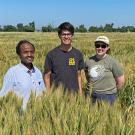
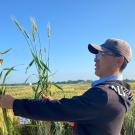
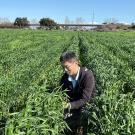
Xiaofei Zhang, in the UC Davis Department of Plant Sciences, has a federal grant to develop bread wheat that will grow short, but without the problems that come with short-stature wheat currently available.
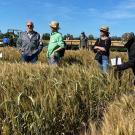
New varieties of wheat, oats, barley and alfalfa are available or are being developed to give growers flexibility for their local growing conditions, weather and markets. Plus, early results from on-going trials in wheat under dry conditions were described during the recent UC Davis Small Grains/Alfalfa Field Day at UC Davis.
Xiaofei Zhang, the new director of the UC Davis Small Grains Breeding Program, outlines the program's priorities, including dual-purpose wheat that farmers can harvest for different uses, depending on water availability and market forces.
UC Davis researchers are exploring how byproducts from anaerobic digesters, rich in nitrogen, can serve as fertilizers for wheat and triticale. Early results show promise for forage crops, potentially reducing chemical fertilizer use and costs.
Xiaofei Zhang started this month as an assistant professor in the UC Davis Department of Plant Sciences, specializing in molecular genetics and breeding of small grains crops. His top priority, he said, will be developing wheat varieties that are highly productive for forage and that also have high grain yield and good quality.
Farmers can use a DIY test—requiring scissors and a garlic press—to check nitrogen levels in crops. This simple method helps boost yields and reduce fertilizer costs and pollution linked to nitrogen overuse.
Doctoral student Valentina Roel is testing compost-based fertilizers from food and yard waste as eco-friendly nitrogen alternatives. Early results show similar crop yields to synthetic fertilizers, offering climate and soil benefits.
UC Davis’ Joshua Hegarty received an $800K USDA grant to breed triticale with better bread-baking qualities while maintaining high yields and low input needs, aiming to boost food security and value for farmers worldwide.
The SCOPE project at UC Davis, led by students, is developing new crop varieties for organic farmers, including improved peppers, tomatoes, sweet potatoes, and flowers. Their work focuses on better taste, disease resistance, and yield.