Astrid Volder and Rachel Noon are collecting all kinds of data from both young and mature almond rootstocks to build a model for below-ground management. Their work is getting international attention.
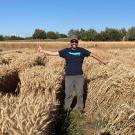
Xiaofei Zhang, in the UC Davis Department of Plant Sciences, has a federal grant to develop bread wheat that will grow short, but without the problems that come with short-stature wheat currently available.
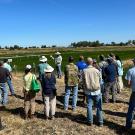
Daniele Zaccaria is organizing the 2026 Advanced School on Microirrigation for Crop Production, which will be offered in California for the first time, from March 30 to April 3.
Walnut trees don't need water early in the season. Supported by a $1.3-million USDA grant, UC Davis scientists are field-testing a new method that lets the trees tell farmers when to start irrigation, saving time, money and a precious resource.
Scientists have developed a new genetic tool that makes it easier and faster to breed grains that grow more efficiently and are better adapted to different environments. They're using a ground-breaking discovery: micro-RNA.
A UC Davis study found most California farmers acknowledge climate change and seek adaptation strategies. Key concerns include water shortages, extreme heat, and wildfires. Farmers need financial aid, research, and policy support to boost resilience.
UC Davis agronomist Bruce Linquist was named a 2024 Soil Science Society of America Fellow for his leadership in sustainable rice farming. His research on reducing tillage and water use helps farmers cut costs while improving soil health.
Problems faced by agriculture amid climate change are closely intertwined with non-ag issues. Solutions often have downsides. We have to embrace the complexity, talk to each other, innovate, use technology and be flexible to find solutions that feed us without causing harm to people and while improving and protecting the environment.
Alfalfa expert Charlie Brummer says it's time to "think about redesigning the alfalfa plant from first principles," after 40 years of frustrated efforts to increase yield. He made the remarks at a recent meeting of the North American Alfalfa Improvement Conference. Students also presented their research, including trials to grow the crop with less water.
UC researchers spent 20 years studying conservation agriculture in California, testing no-till, cover cropping, and residue management. Their findings show long-term benefits for soil health, water retention, and crop resilience, guiding future farming.