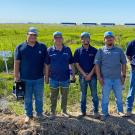
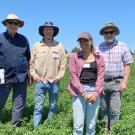
UC Davis researchers are evaluating new herbicides and no-till cultivation methods to address challenges in California rice production, including herbicide resistance, water scarcity, and production costs. Trials indicate potential benefits and trade-offs.
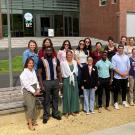
Valentina Roel Rezk was among graduate students from around the world who participated in a summer program seeking to shape future policy and research into circular food and agriculture systems. The program was put on by the Circular Food Systems Network, hosted by Wageningen University & Research, in the Netherlands.
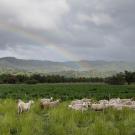
Problems faced by agriculture amid climate change are closely intertwined with non-ag issues. Solutions often have downsides. We have to embrace the complexity, talk to each other, innovate, use technology and be flexible to find solutions that feed us without causing harm to people and while improving and protecting the environment.
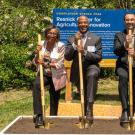
Construction officially began on the Lynda and Stewart Resnick Center for Agricultural Innovation with a groundbreaking event on May 29, celebrating the future $64.4 million facility at the University of California, Davis.
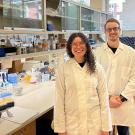
Two UC Davis graduate students, Jennifer Cribbs and Nina Venuti, received nearly $100K each from CalFire to support forest restoration. Their research on tree resilience and seed collection aims to aid reforestation and ecosystem management in California.
Alfalfa offers a drought-resilient, high-protein crop for both livestock and human use. UC Davis researchers are exploring ways to improve yield, protein extraction, and resilience while testing almond shells as a soil amendment to enhance water infiltration.
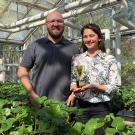
UC Davis' Strawberry Breeding Program develops resilient, high-quality varieties for growers worldwide. It has released 12 commercial varieties in nine years, supporting California's $2.7B industry.
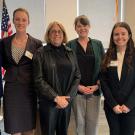
Graduate student Paige Kouba shared her climate-focused forest research with lawmakers at the state Capitol, part of a program training scientists to inform California policy through clear, nonpartisan science communication.
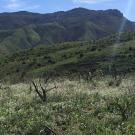
Air pollution and invasive weeds threaten fire-adapted wildflowers in the Santa Monica Mountains. Nitrogen from smog boosts invaders, reducing native seed banks and long-term biodiversity after wildfire recovery.
UC Davis plant scientist Grey Monroe won a $1M NSF CAREER Award from the National Science Foundation to study how plants protect key genes from harmful mutations. His work could boost gene editing and crop resilience and involve underrepresented high school students.